


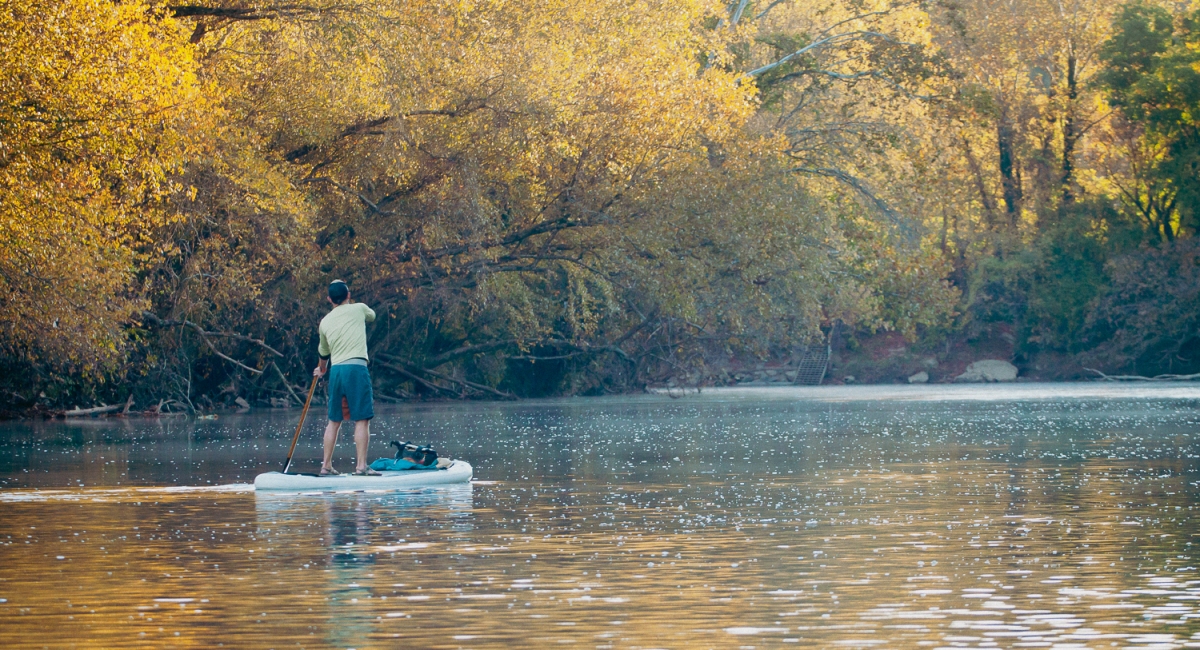
This is the story of one of the world's oldest rivers, and the Asheville lodge named after its rebellious current.
Most rivers in the eastern United States behave themselves. They form in the mountains, roll downhill toward the coast, and empty into the Atlantic. Simple. Predictable. Orderly.
The French Broad River didn't get that memo.
Winding northward through the heart of Western North Carolina, the French Broad has been confusing cartographers, geologists, and casual onlookers for centuries. It cuts directly through the Appalachian Mountains rather than flowing away from them. It runs in what most people would call the "wrong" direction. And it's been doing this for somewhere between 260 and 340 million years, making it one of the oldest rivers on the planet.
That stubborn, go-your-own-way spirit is exactly why we named our lodge after it.
A River Older Than the Mountains
Here's the part that bends most people's brains: the French Broad River is older than the Appalachian Mountains themselves. Geologists believe the river was already flowing through this region long before the Alleghanian orogeny (the tectonic collision that built the Appalachians) began roughly 300 million years ago. When the supercontinent Gondwana collided with North America, the mountains didn't redirect the river. Instead, the mountains rose up around it.
Think about that for a second. The French Broad has been holding its line while entire mountain ranges formed, eroded, and reformed around it. It ranks as the third oldest river in the world, behind only Australia's Finke River and its North Carolina neighbor, the New River. Both the French Broad and the New River are older than the dinosaurs, older than most of the continents as we know them, and older than nearly every other natural feature you'll encounter in your lifetime.
When you're standing on the banks of the French Broad in Asheville, you're looking at something genuinely ancient. Not "old building" ancient. Not "Roman Empire" ancient. We're talking hundreds of millions of years ancient.
So Why Does It Flow North?
The French Broad River flows northward (and westward) because it was here first. Most eastern rivers formed after the Appalachian Mountains were already in place, so they naturally drain away from the ridgeline toward the coast. The French Broad had already established its course before those ridges existed. As the mountains slowly pushed upward over millions of years, the river kept cutting through them at roughly the same rate they grew. Geologists call this an "antecedent" river; a waterway that maintains its original path despite tectonic changes happening around it.
The result is a river that appears to flow the "wrong way." It starts in the mountains of Transylvania County near Rosman, NC, flows north through Brevard and Asheville, crosses into Tennessee, and eventually joins the Tennessee River system, which feeds into the Ohio, then the Mississippi, and finally the Gulf of Mexico. Instead of taking the short route east to the Atlantic (roughly 200 miles), the French Broad's water travels thousands of miles west and south to reach the sea.
It's the long way around. The scenic route. The wrong way, if you're in a hurry. But if you're not? It's the best way.
Where the Name "French Broad" Comes From
The river's name is a piece of colonial history layered on top of something far older. The Cherokee people lived along this river for thousands of years before European contact. Folklorists recorded a possible Cherokee name for the river, Tselica, though scholars believe this may have described a specific feature or bend rather than the entire waterway. The Cherokee traditionally named individual places along a river (crossings, fishing grounds, notable rocks) rather than the full waterway itself.
The English name first appears in written records around 1777. At the time, there was already a "Broad River" flowing eastward through the Carolinas. This other river needed a distinction, so settlers added "French" to the one whose waters drained west into the Mississippi Basin, territory that had been claimed by France until the 1763 Treaty of Paris ended the French and Indian War. The "Broad" part simply described the river's wide, generous character as it passes through the valleys.
So "French Broad" is essentially a colonial shorthand: the broad river that flows toward what used to be French territory. Not the most poetic origin story, but an honest one.
The French Broad River Through Asheville
Today, the French Broad River through Asheville is the centerpiece of outdoor life in Western North Carolina. The river passes directly through the city, connecting neighborhoods, parks, greenways, and some of the region's best recreation.
From May through September, the river comes alive with rafters, kayakers, tubers, and paddleboarders. Outfitters run guided whitewater trips through sections with Class I-IV rapids, while calmer stretches near the River Arts District are perfect for a lazy afternoon float. Even in the shoulder months of March, April, and October, whitewater rafting trips are still available for those who don't mind cooler water.
The French Broad River Greenway runs along the banks, connecting cyclists and walkers to breweries, restaurants, galleries, and parks. It's one of the reasons Asheville feels like a city built around the outdoors rather than a city that happens to have some nature nearby.
Why We Named Our Lodge After a "Wrong Way" River
When we built Wrong Way River Lodge & Cabins, the name wasn't random. It was a nod to the river that runs right past our front door, and to the idea that the best path isn't always the obvious one.
The French Broad doesn't follow the expected route. It goes its own way, and it's been doing that longer than almost anything else on Earth. That felt like the right spirit for a place that's a little different from what you'd expect, too. We're not a traditional hotel. We're not a campground. We're Asheville's only outdoor hotel: modern A-frame cabins along the French Broad River greenway with real beds, private bathrooms, HVAC, and river access, located just 1 mile from the River Arts District, 2 miles from the Biltmore Estate, and 3 miles from downtown Asheville.
There's something about staying on the banks of a river that's been flowing for 300 million years that puts things in perspective. Your phone notifications feel a little less urgent. The to-do list back home can wait another day. The river has been going its own way since before the dinosaurs, and it's doing just fine.
Maybe there's a lesson in that.
Experience the French Broad River from Wrong Way
Whether you're here to paddle, hike, explore the dog-friendly trails nearby with your pup, or just sit by the water and do absolutely nothing, Wrong Way puts you right where the action is (or isn't, depending on your mood).
Our A-frame cabins sit along the French Broad River greenway, giving you direct access to one of the oldest rivers in the world without sacrificing comfort. Wake up, grab your coffee, walk to the river. It's that simple.
The French Broad by the Numbers
The French Broad River stretches approximately 218 miles from its headwaters near Rosman, NC to its confluence with the Holston River in Knoxville, Tennessee. It drains over 2,800 square miles of Western North Carolina and Eastern Tennessee. At an estimated 260 to 340 million years old, it predates the Appalachian Mountains, the Atlantic Ocean, and every dinosaur that ever walked the Earth. The river drops roughly 2,000 feet in elevation from source to mouth, creating everything from calm, floatable stretches near Asheville to serious whitewater sections in the gorge. Today, the French Broad River corridor supports dozens of outdoor recreation outfitters, hundreds of miles of greenway trails, and one outdoor hotel that thought naming itself after the river's most rebellious quality was a pretty good idea.
The French Broad has been going the wrong way for 300 million years. Come see what all the fuss is about.
Stay on the Banks of a 300-Million-Year-Old River
Book an A-frame cabin at Wrong Way River Lodge & Cabins and wake up next to the French Broad. River access, greenway trails, and Asheville adventures are right outside your door.
Photo Credit: Preview photo courtesy of Chris Burkard.